
Comments in C Language !

C Comments

RephraseCode comments serve the purpose of both explaining code and enhancing its readability. Additionally, they can be utilized to prevent test execution when exploring alternative code options.

Comments are a type of code annotation that can be expressed in a single line or multiple lines.

Single-line Comments

Two slashes in succession (//) are used to denote single-line comments.

Any text that is placed between // and the end of the line will be ignored by the compiler and will not be executed.

This illustration demonstrates the use of a comment on a single line before a line of code. 


C Multi-line Comments

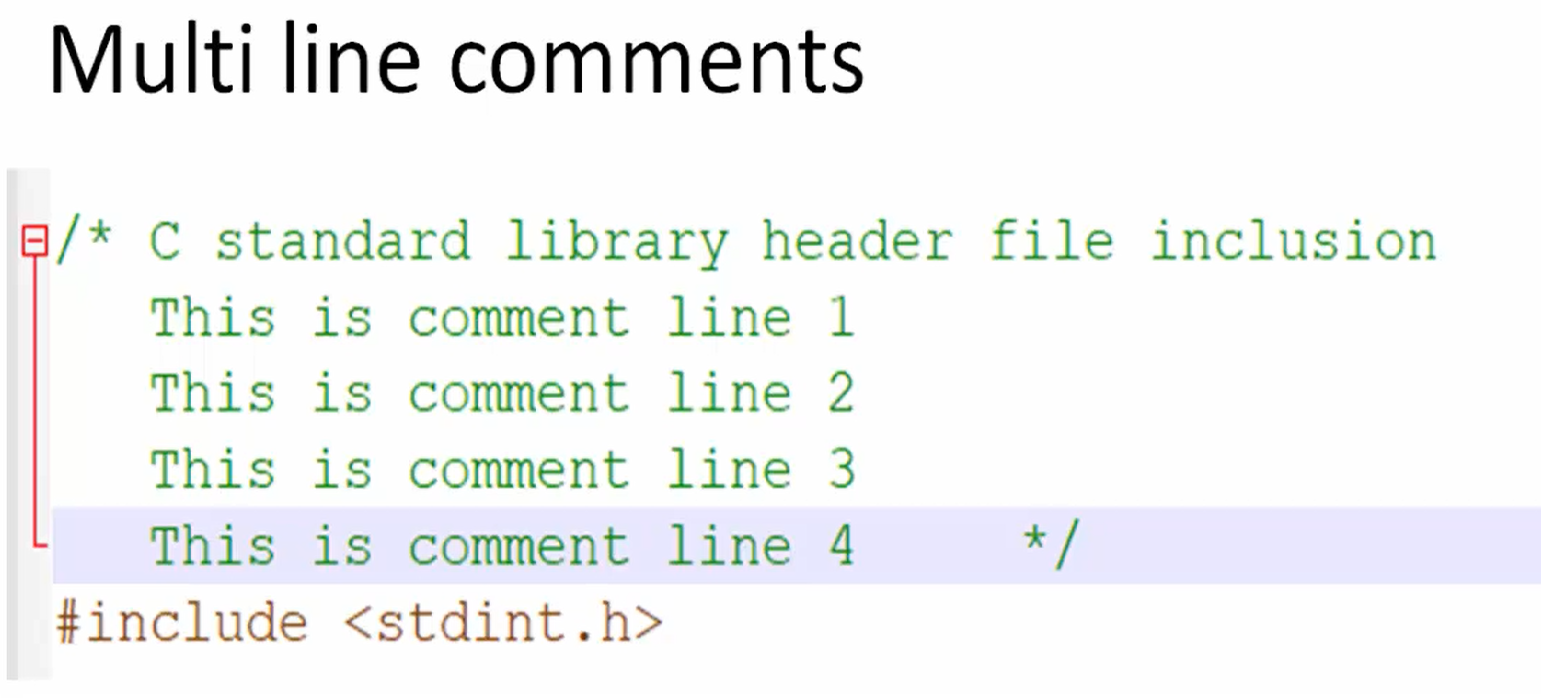
Multi-line comments start with /* and ends with */. Any text between /* and */ will be ignored by the compiler:


Comments

Popular posts from this blog

C Language Introduction

C Langauge What is C? C is a general-purpose programming language created by Dennis Ritchie at the Bell Laboratories in 1972. It is a very popular language, despite being old. C is strongly associated with UNIX, as it was developed to write the UNIX operating system. Why Learn C? It is one of the most popular programming language in the world. If you know C, you will have no problem learning other popular programming languages such as Java, Python, C++, C#, etc, as the syntax is similar. C is very fast, compared to other programming languages, like Java and Python. C is very versatile; it can be used in both applications and technologies.   Difference between C and C++- C++ was developed as an extension of C, and both languages have almost the same syntax The main difference between C and C++ is that C++ support classes and objects, while C does not. C Install IDE An IDE (Integrated Development Environment) is used to edit AND compile the code. Popular IDE's include Code::B...

Syntax in C !

Syntax in C Example-   Example explained Line 1: #include <stdio.h> is a header file library that lets us work with input and output functions, such as printf() (used in line 4). Header files add functionality to C programs. Don't worry if you don't understand how  #include <stdio.h> works. Just think of it as something that (almost) always appears in your program. Line 2: A blank line. C ignores white space. But we use it to make the code more readable. Line 3: Another thing that always appear in a C program, is main() . This is called a function. Any code inside its curly brackets {} will be executed. Line 4: printf() is a function used to output/print text to the screen. In our example it will output "Hello World!". Note that: Every C statement ends with a semicolon ; Note: The body of int main() could also been written as: int main(){printf("Hello World!");return 0;} Remember: The compiler ignores white spaces. Howev...